
You have a strong property, a fair price, and a market full of buyers with money to spend. And still the enquiries do not come. The reason is rarely the property itself. It is almost always the marketing around it – or the absence of a strategy holding it together.
Real estate marketing on the Costa del Sol does not work like selling a home in your domestic market. Your buyer is often abroad, researches in another language, and weighs your listing against the entire coast before booking a single flight. Reaching that buyer takes more than a portal listing and a few photos. It takes the right channels, used in the right order, at the right moment in the buyer's journey. This article shows how those pieces fit together – and where most agents and developers leave enquiries on the table.
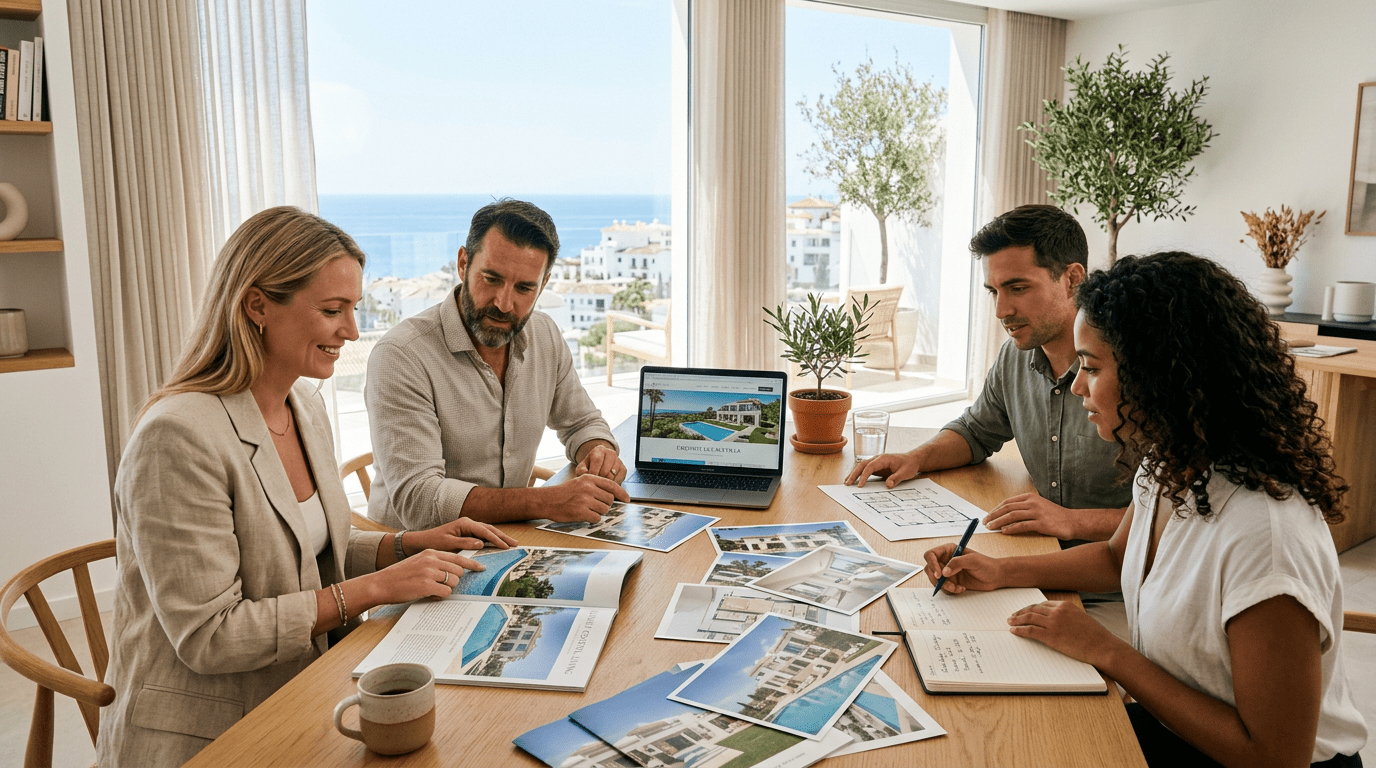
Why real estate marketing on the Costa del Sol follows different rules
Start with the numbers, because they reframe the whole task. Across Spain, foreign buyers account for roughly 12 percent of home purchases. In Málaga province, that share reached around 32 percent of all transactions in 2024 – nearly three times the national average and among the highest in the country, alongside Alicante and the Balearic Islands (source: Spanish Property Registrars / idealista, 2024).
Move up into the premium segment and the picture becomes even clearer. In Marbella's luxury market, foreign buyers have accounted for more than 80 percent of transactions in recent years (source: DM Properties; idealista luxury report, December 2025). In practice, anyone marketing a mid-range property or above on the Costa del Sol is marketing to an international audience – whether they have planned for it or not.
This changes how you reach buyers. Your prospect is often in London, Hamburg, Stockholm, or Brussels when they first encounter your project. They do not know the local agencies, the neighbourhoods, or which developments are credible. That picture forms entirely through the channels they consume while researching – months before they land. So the real question is not "how do I advertise this property?" It is "where is my buyer looking while they decide, and am I visible there?" Real estate marketing on the Costa del Sol is the discipline of answering that question well.
The cost of being invisible during the research phase
International buyers do not discover a project and purchase it in the same week. They prepare, often for six to eighteen months, moving through the recognisable stages of the international buyer's journey: early research, shortlist, a confirming visit, then decision. The shortlist is the stage that decides everything – and it forms long before the buyer ever contacts an agent.
Here is what that means in practice. By the time a buyer walks into a sales office, they are not there to discover options. They are there to confirm a list they built at home, from the portals, articles, magazines, and recommendations they trusted during research. If your project did not appear in those channels, it is not on the list they bring with them. You never enter the conversation, and you never see the enquiry that did not happen.
This is the quiet cost most marketing budgets ignore. It is easy to measure the listing you paid for. It is much harder to see the qualified buyer who shortlisted three competitors and never knew you existed. Closing that gap is the entire point of a marketing strategy – and it is why a single channel is never enough.
The channels that actually move international buyers
No single channel sells a Costa del Sol property on its own. What works is a combination, with each channel doing a specific job at a specific stage of the journey.
Property portals capture buyers who are already searching with intent. They are essential – and also where every competing listing sits side by side. Strong visuals are what make yours stand out in a wall of thumbnails, which is why professional photography, video, and drone footage is the foundation of every other channel, not an optional extra.
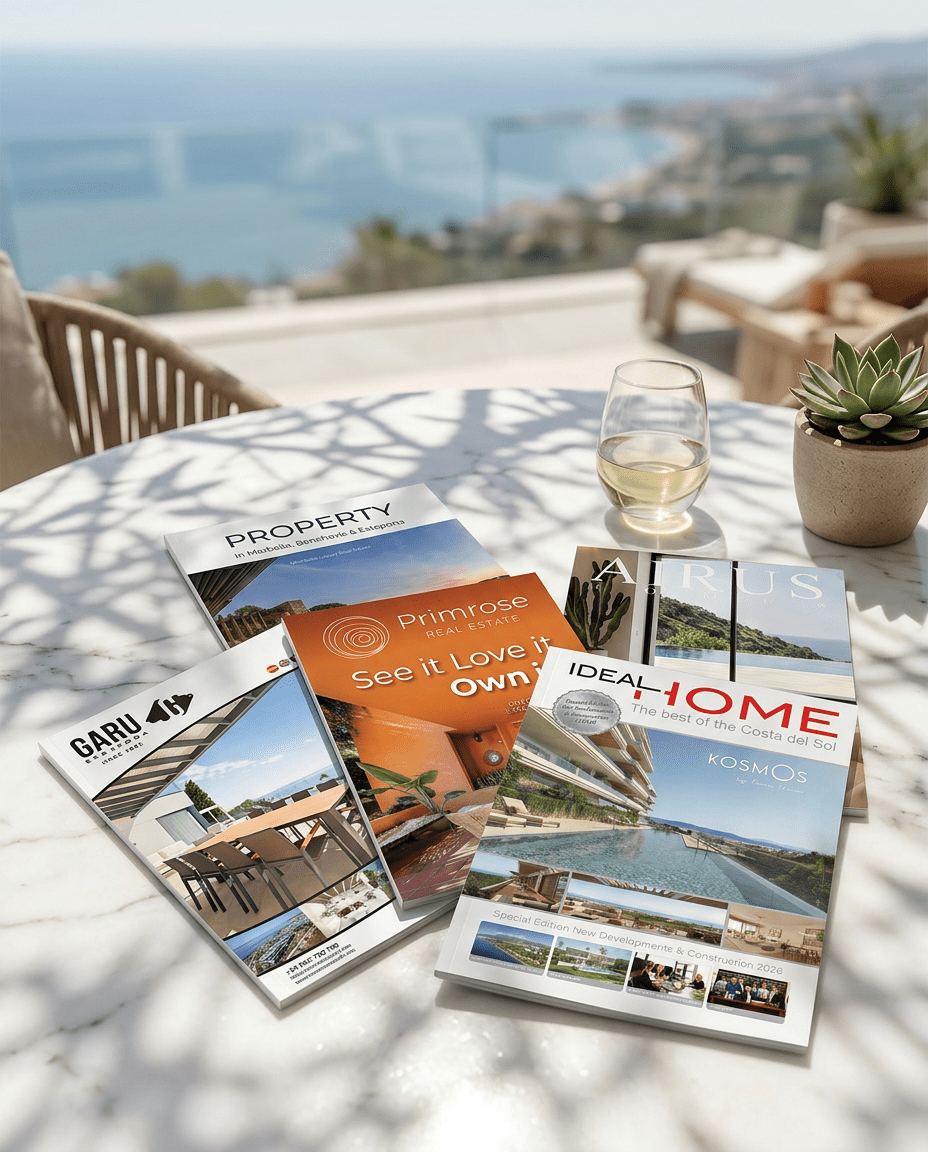
Print and editorial media reach buyers earlier, during research, and carry a credibility paid advertising cannot replicate. A property featured editorially in a trusted magazine is not "an ad" in the buyer's mind – it reads as a recommendation. For the high-purchasing-power audience between 45 and 65, who still value considered, printed information, this remains a decisive touchpoint.
Your website and social channels are where interested buyers confirm that you are real, professional, and worth contacting. Consistent visual language across all of them signals quality before a single word is read.
Language and targeting sit on top of everything. A German buyer who finds your project communicated clearly in German, in a tone that matches their expectations, is far more likely to engage than one left to translate a Spanish listing themselves. With German and Nordic buyers among the fastest-growing groups on the coast, that is not a nice-to-have – it is a competitive edge.
The visual content that actually converts: from first scroll to confirmed viewing
Not all visual content does the same job. Each format serves a specific stage of the buyer's journey, and understanding that changes how you allocate your production budget.
Professional photography is the non-negotiable starting point. It is the first impression on every portal, magazine page, and social post. Buyers make a subconscious quality judgment within seconds of seeing the first image – a poorly lit or wide-angle-distorted interior tells them the property (and the agency) does not take quality seriously. Everything else you invest in amplifies your photography, so it is the one area where cutting corners costs the most.
Walkthrough video does what photography cannot: it gives the buyer a sense of space, flow, and atmosphere. For an international buyer who cannot easily fly out for a first look, a well-produced property video replaces the initial visit. It filters out unqualified enquiries and brings in buyers who are already oriented when they contact you.
Drone and aerial footage answers the location question that portal maps never fully resolve. Where exactly is the plot? How close is the golf course? What are the sea views like, and from which rooms? A two-minute aerial sequence answers all of this more convincingly than any map pin. For hillside villas, beachfront developments, and golf-front plots, aerial footage is often the content that converts a shortlist entry into a booked flight.
360° virtual tours give the buyer control. They can revisit the property at midnight in Hamburg, share it with their partner, and walk through every room at their own pace. For developers with a showflat and multiple unit types, a 360° tour dramatically extends the sales tool's reach beyond the people who physically visited it.
Construction timelapse solves the trust problem unique to off-plan sales. A buyer committing to a property that does not yet exist is taking a significant leap of faith. A timelapse camera installed from day one of construction creates a continuous stream of evidence – the project is real, it is on schedule, and the developer delivers. That footage becomes the most credible sales content you can show a hesitant buyer, and it generates social media material throughout the entire build period at no extra production cost.
The practical implication: produce all formats in a single shoot session where possible. The variable cost of adding video or a 360° tour to an existing photography appointment is small. The cost of returning to a property for a separate session – or of launching without it – is much larger.
How ADS Marketing builds your visibility across the whole journey
ADS Marketing exists to solve exactly this problem: making a property visible in the right channel, at the right moment, in the right language. After 18 years of producing Ideal Home magazine and working directly with developers and agents on the Costa del Sol, the focus is the full marketing system – not isolated tactics.
It starts with the visual foundation: photography, video, drone, and timelapse that make your property compelling on every channel it appears. From there, editorial visibility builds credibility where buyers form their shortlists – through the Ideal Home magazine for international buyers, and the agency magazine for reaching other professionals in the market. For German-speaking buyers specifically, Spanientrends adds a dedicated digital channel that meets the DACH audience in its own language.
The advantage of working from one strategy is consistency. Picture a developer launching a new project: the same villa, shot once to a professional standard, then carried across a portal listing, a magazine feature, and a German-language digital placement. To the buyer, those touchpoints reinforce each other – the project looks established, credible, and worth a visit. The alternative, three disconnected listings of varying quality in three places, quietly undermines the same property. Consistency is not a design preference. It is what turns scattered spend into a shortlist place.
The German-speaking buyer: why dedicated language marketing changes enquiry quality
If you are marketing properties on the Costa del Sol and not actively reaching the German-speaking market, you are overlooking one of the most committed buyer groups on the coast. Germany, Austria, and Switzerland consistently rank among the top three source countries for international property purchases in Málaga province – and the profile of these buyers makes them worth reaching deliberately.
DACH buyers tend to research intensively before making contact. They read long-form editorial, compare multiple sources, and often take 12 to 18 months from first interest to purchase. That research behaviour means early-phase visibility – before the shortlist is formed – is especially valuable with this audience. They are also disproportionately likely to purchase in the higher price brackets: the combination of purchasing power, research discipline, and a genuine affinity for the Costa del Sol makes them among the most qualified international buyers in the market.
The challenge is language. A German buyer who encounters your project only in Spanish or English – with no signal that you understand their market, their expectations, or their language – will simply move to a competitor who does. They are not being difficult; they are doing what any informed buyer does, which is gravitate toward the option that feels most professional and trustworthy.
This is the audience that Spanientrends is built for: German-language editorial and listings content that reaches DACH buyers during their research phase, in their own language, with the visual standard they expect. For developers and agencies with properties above €400,000, it is one of the highest-return channels available on the coast – precisely because so few competitors are using it consistently.
Five principles of effective real estate marketing on the Costa del Sol
Whether you run marketing in-house or with a partner, these principles separate campaigns that generate enquiries from those that quietly disappear:
- Lead with visuals. Every channel starts with the image. Invest in professional photography and video first, because everything else amplifies it.
- Be visible during research, not only at decision time. The shortlist forms months before the viewing. Editorial and print place you on that list before competitors who only advertise at the end.
- Speak the buyer's language – literally. Communicate in German, English, and the relevant languages of your audience, not only in Spanish.
- Keep one consistent message across channels. A buyer who sees the same quality on the portal, in print, and on your website trusts it faster.
- Measure what generates enquiries, not just clicks. The goal is qualified contact from real buyers, not vanity traffic. Build your mix around that.
Conclusion: strategy beats single tactics
The Costa del Sol rewards sellers who think in systems. International buyers prepare for months, compare relentlessly, and choose the projects that show up – professionally and consistently – everywhere they look. A great photo, a portal listing, or a magazine page on its own will not win them. The combination, used deliberately, will.
Real estate marketing on the Costa del Sol is not about doing more. It is about doing the right things in the right order. Get the strategy right, and the enquiries follow.
Frequently asked questions about real estate marketing on the Costa del Sol
What makes real estate marketing on the Costa del Sol different from other markets?
The Costa del Sol has one of the highest concentrations of foreign buyers in Spain – around 32 percent in Málaga province, versus 12 percent nationally. Your buyer is typically based abroad when they start researching, comparing your project against others across the entire coast and beyond. This means you need visibility across multiple channels and languages months before a buyer visits, not just a local portal listing.
Which visual content has the biggest impact on enquiry rates?
Professional photography is the baseline – without it, every other channel underperforms. After that, drone footage showing the property's location and views generates the strongest engagement for villas and new developments. For off-plan projects, construction timelapse is especially effective because it builds continuous trust over the entire sales period. 360° virtual tours help convert shortlisted buyers who cannot visit easily, by letting them explore at their own pace from home.
How important is German-language marketing for Costa del Sol properties?
Very important, particularly for properties above €400,000. German, Austrian, and Swiss buyers rank among the top international buyer groups in Málaga province. They are research-intensive, typically spend 12–18 months evaluating before purchasing, and strongly prefer content in their own language. A German-language platform like Spanientrends reaches this audience during the research phase – before the shortlist is formed – which is when visibility has the highest commercial value.
Do I need magazine advertising if I am already on property portals?
Portals and editorial media serve different stages of the buyer journey and should be used together, not as alternatives. Portals capture buyers who are actively searching – they are already comparing options. Editorial magazine features reach buyers earlier, during the research and inspiration phase, before they have a shortlist. A buyer who encounters your project editorially first will engage with your portal listing with far more confidence and intent. The two reinforce each other.
How long does it take for a real estate marketing campaign to generate enquiries?
It depends on the channel. A portal listing with strong visuals can generate enquiries within days. Editorial and print placements work on a longer cycle – typically two to six months – because they influence buyers earlier in their journey. The distinction matters: portal enquiries are often in early exploration mode, while buyers who contact you after seeing editorial coverage tend to be better qualified, because they already know your project and have chosen to seek you out.
Want to find out how ADS Marketing can help your business? Get in touch – we would love to build the right marketing strategy for your properties.