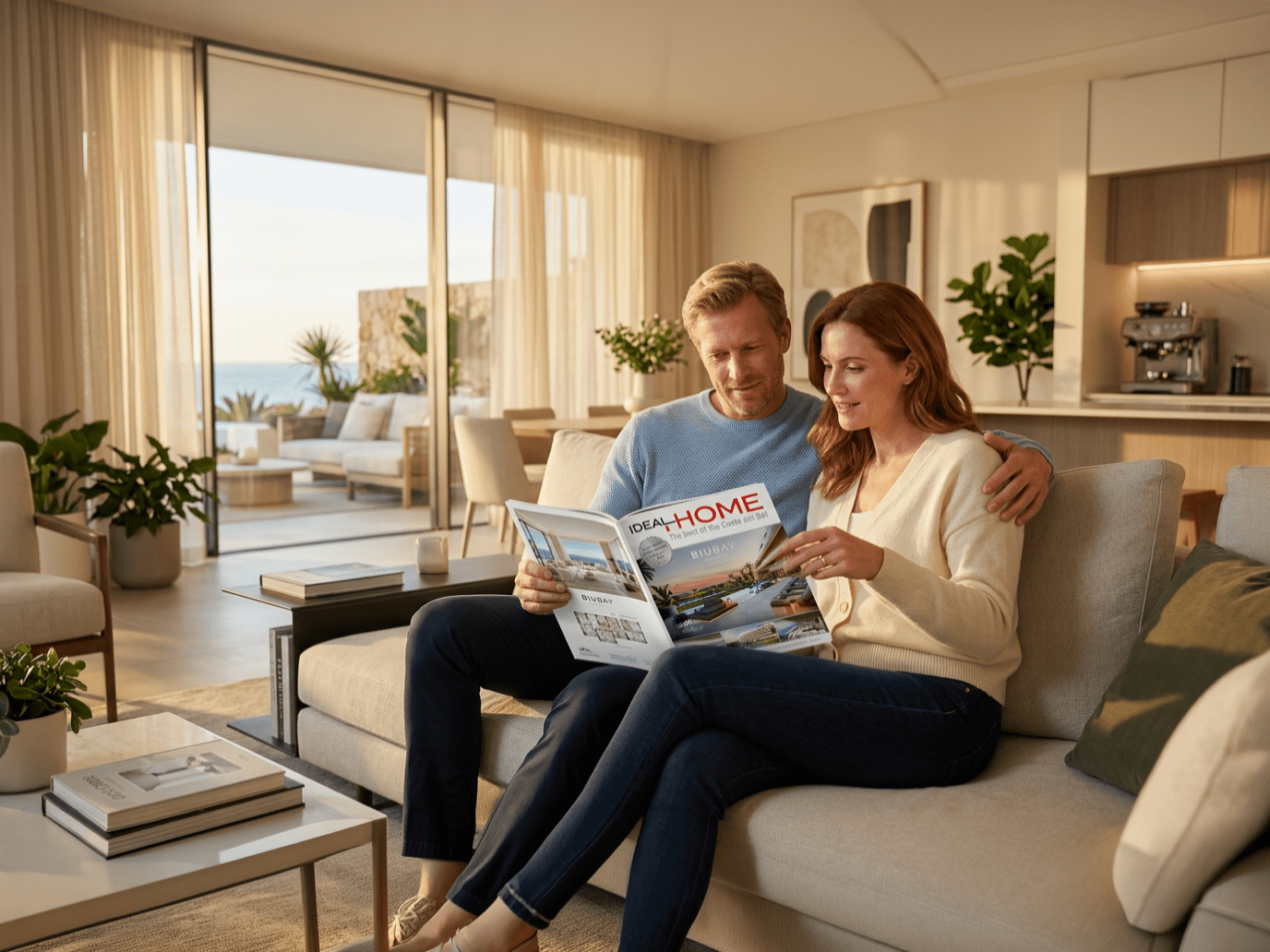
A couple from California is planning their retirement. Spain has been on their shortlist for years — the climate, the lifestyle, the value for money compared to Southern France or Italy. They are not clicking on Facebook ads. They are reading a real estate magazine in Spain that a friend recommended, working through area guides and market articles over a Sunday morning coffee. Halfway through, they come across a development on the Costa del Sol. The name sticks. Three months later, when they book a viewing trip, that is the first agency they call.
This kind of journey happens more often than most agents and developers realise. In a competitive market for international buyers, the channels that build trust matter just as much as the channels that generate clicks. A well-positioned real estate magazine in Spain reaches buyers at a different stage of their decision process — when they are researching, forming opinions, and deciding who they want to work with long before they make contact.
This article explains why editorial magazine presence remains one of the most effective tools for reaching international property buyers on the Costa del Sol — and what the evidence actually supports.
Why International Buyers Respond Differently to Media
When a buyer from the UK or the United States begins researching property in Spain, they face a significant amount of uncertainty. The legal system is different. The buying process is unfamiliar. The market is fragmented across dozens of agencies with no single trusted authority. In this context, trust becomes the primary filter — and trust is not something a banner ad can reliably build.
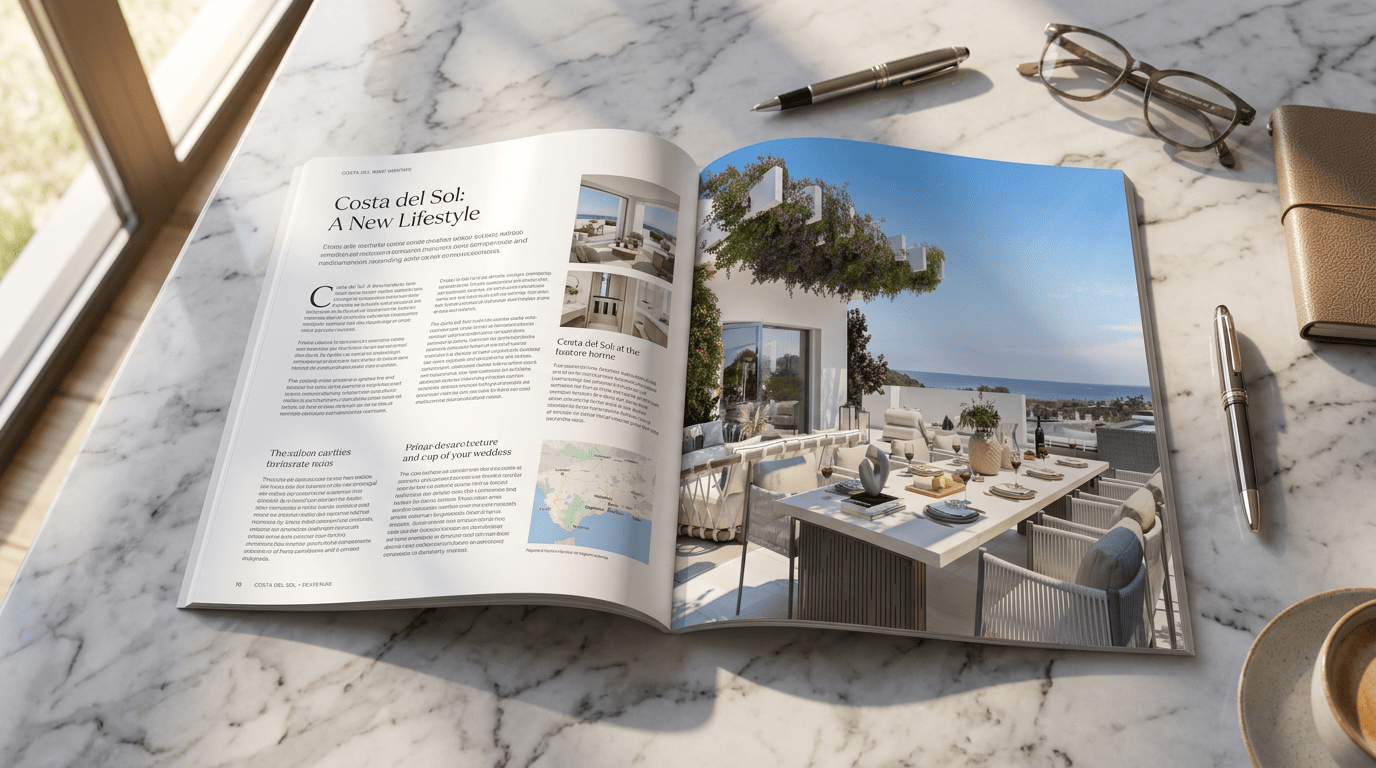
A well-produced property magazine does something structurally different. It places your properties and agency within a curated editorial context — and that context transfers credibility directly to you. Research published by Magnetic, the marketing body for UK magazine media, puts a number on this transfer: brands advertising in magazine environments saw an average uplift across trust-based KPIs of between 64% and 94%, driven by what the study calls the brand rub effect. It is industry-funded research and worth reading with that in mind — but it is methodologically transparent, and it remains the most detailed analysis of magazine advertising effectiveness currently available.
This matters because international property buyers are not impulsive. They typically spend months — often more than a year — in an active research phase before making first contact with an agent. During that phase, they consume editorial content, follow market trends, and look for signals about which professionals understand their needs as foreign buyers. A real estate magazine in Spain that speaks directly to that audience, with relevant editorial content, meets them exactly at the moment when impressions are being formed.
The Costa del Sol is one of the most internationally competitive property markets in Europe. Agents and developers who rely exclusively on portal listings and paid social ads are competing on price and visibility alone. Those who invest in editorial presence are competing on something harder to outbid.
What the Evidence on Budget Structure Says
Set aside the trust statistics for a moment. There is a body of research on how marketing budgets should be structured that has nothing to do with the print industry — and it is more useful here than anything published by a magazine publisher.
Les Binet and Peter Field analysed roughly a thousand campaign case studies from the IPA Effectiveness Databank, covering the period from 1980 onward. Their conclusion, published as The Long and the Short of It, is that profit is maximised when budget is split between long-term brand building and short-term sales activation — with a starting point of roughly 60% to 40% (IPA). It is an average across sectors rather than a fixed rule, and the right ratio shifts with how established a business is. But the direction has held across four decades of data.
What makes this relevant right now is what the industry has actually been doing. In 2024, 68.8% of marketing budgets went to short-term performance tactics, up from 59.9% the year before — leaving brand building at 31.2% (WARC). More than half of marketers now name short-termism as a significant problem in their industry, up from a quarter in 2022. The gap between what the evidence recommends and what budgets actually do has rarely been wider.
For real estate specifically, these dynamics are amplified. Property is a high-stakes, low-frequency purchase. Buyers are highly motivated to research carefully, and they are acutely sensitive to signals of quality and professionalism. The media environment in which your properties appear becomes part of how buyers evaluate you — before they have ever spoken to you.
Why This Matters More in 2026 Than It Did Two Years Ago
The market has shifted underneath this question. Málaga province recorded 8,837 residential sales in the first quarter of 2026 against 9,741 a year earlier, a drop of around 9.3% (El Debate, 2026). Yet in the second quarter, purchases by foreign buyers grew by roughly 11% year on year while purchases by Spanish buyers declined (idealista, 2026). Foreign buyers now account for 34.30% of all purchases in the province, up from 25.64% in 2021.
In other words: the segment this magazine is built to reach is the segment that is growing, in a market where overall volume is falling. We have written about what that means for budget allocation in more detail in Beyond Digital, including the parts where print is the wrong answer.
How a Real Estate Magazine in Spain Reaches the Right Buyers
The Ideal Home Magazine is an English-language property publication produced specifically for the Costa del Sol market. It targets international buyers from the UK, the United States, and other English-speaking markets — audiences that are actively looking for trusted, accessible information about buying property in Spain.
This is not a listings directory. The magazine combines editorial content — area guides, lifestyle features, market analysis, and practical buying advice — with selected property advertising. That editorial framework is what gives advertiser placements their value. Your property appears in a context that buyers find genuinely useful, not alongside content they are trying to skip.
Distribution covers both print and digital. The print run is 25,000 copies, placed across more than 250 locations between Benalmádena and Sotogrande: luxury hotels, golf clubs, beach clubs, high-end restaurants, tourist offices and real estate offices. One edition per year, in circulation from May through December, with the digital edition staying online until the next issue replaces it. That gives a placement a working life measured in months rather than in the days a paid campaign runs before the budget stops.
For agents and developers, the practical implication is meaningful. When a buyer from London or Los Angeles arrives on the Costa del Sol for a viewing trip, they often come with preferences already formed. The Ideal Home Magazine is one of the tools that shapes those preferences before the trip begins — and before your competitors have had a chance to make an impression.
How Magazine Presence Fits Into a Broader Marketing Strategy
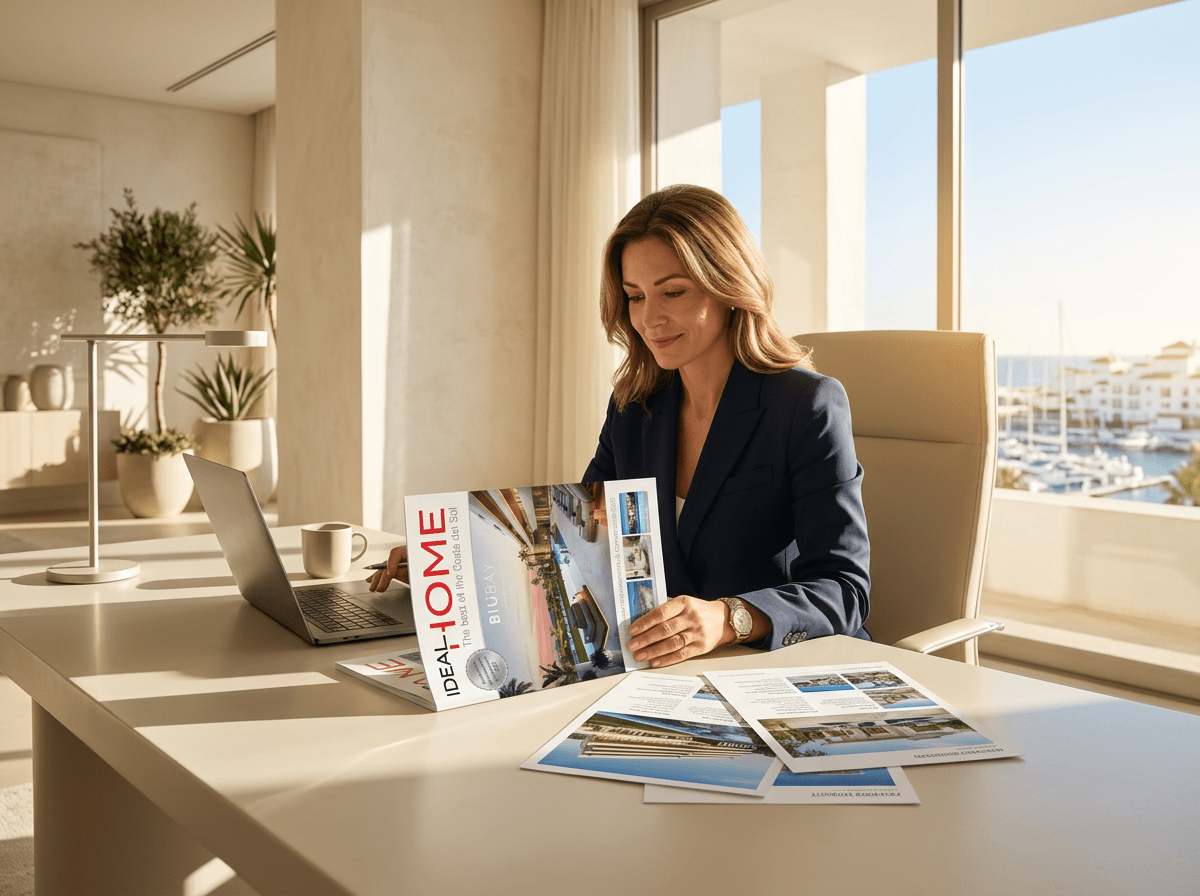
The most effective real estate marketing on the Costa del Sol uses multiple channels in combination. Portal listings generate search visibility. Professional photography and video create the visual impact that stops a buyer mid-scroll. Social media builds ongoing brand awareness. And editorial magazine placement builds the credibility that converts an interested reader into an actual enquiry.
At ADS Marketing, we work with agents and developers across the Costa del Sol to build strategies that combine these elements. Our photography, video, and drone production services feed directly into magazine placements — because a well-photographed property performs better in every medium. The components are designed to work together, not in isolation.
For agents who have not yet considered magazine advertising as part of their mix, the relevant question is not whether editorial media works. The question is whether it fits your timeline, your budget structure and your buyer profile — and whether your competitors have already answered that question ahead of you.
Practical Tips for Getting the Most from Magazine Advertising
If you are considering a presence in a real estate magazine in Spain, these principles will help you maximise the return on that investment.
Use professional photography. Magazine placement amplifies whatever visuals you provide. Properties photographed with mobile phones or low-quality cameras look out of place next to professionally produced editorial content. High-quality images are not optional — they are the baseline for making your listing competitive in this environment.
Be consistent. A single appearance in one issue has limited impact. Buyers who encounter your name or development across multiple issues develop a sense of familiarity that builds over time. Consistency signals that you are an established presence in the market — not a one-time advertiser testing the water.
Combine your listing with an editorial angle. The most effective magazine placements appear in context — alongside relevant area guides, lifestyle content, or market analysis. Work with your magazine partner to identify the placement that best fits your property type and target buyer profile.
Track your enquiries. Magazine advertising works over time, not overnight. Ask buyers who contact you how they first heard about you. You may find that more of them mention the magazine than you expect — particularly buyers who arrive from overseas already knowing your name and your properties.
Conclusion: Visibility Is Not Enough — Credibility Is the Goal
In a market as competitive as the Costa del Sol, most agents and developers have access to the same portals, the same social platforms, and broadly the same digital advertising tools. What differentiates the professionals who consistently attract international buyers is not access to more channels — it is the quality and credibility of their presence in the right ones.
A real estate magazine in Spain that is built for international buyers gives your properties a context that portal listings and paid ads cannot replicate: editorial credibility in a publication that buyers have actively chosen to read, with a working life measured in months.
The Ideal Home Magazine has been designed specifically to create that opportunity for real estate professionals on the Costa del Sol. If reaching British and American buyers more effectively is a priority for your business, it is a channel worth taking seriously.
Want to find out how ADS Marketing can help your business reach international property buyers? Learn more about the Ideal Home Magazine — or get in touch directly. We would love to hear from you.
Sources
- Magnetic — A Matter of Trust and effectiveness analyses. Magnetic is the marketing body for UK magazine media; this research is industry-funded.
- Binet & Field / IPA Effectiveness Databank — The Long and the Short of It
- WARC — Performance budgets rise at the expense of brand
- El Debate (2026) — Málaga residential sales, Q1 2026
- idealista (2026) — Foreign purchases up 11% in Q2 2026; foreign buyer share by province via Registradores data (2026)