Your buyer reads you twice. Once on the coast, leafing through a magazine at a hotel reception. And once back home in Manchester or Utrecht, scrolling through the digital edition while planning the next trip. When you book a page in a magazine, you are booking two channels. Each has a different lifespan, different distribution and different readers.
Whether print belongs in your budget at all is the question we worked through in Beyond Digital. This article picks up one step later: the ad is booked, or nearly. What do you need to do so that it works in both channels?
Who reads you here, and who researches you from home
The Costa del Sol market is becoming more international even as fewer homes change hands. According to the Colegio de Registradores, foreign buyers accounted for 38.83% of home purchases in Málaga province in the third quarter of 2026, up from 37.01% the quarter before. Across Spain the share reached 16.05%, the highest since records began. Meanwhile total purchases fell to 164,148, down 5.9% on a year earlier.
British buyers lead the foreign ranking with 7.48%, followed by Moroccan, Dutch (5.83%) and German (5.70%) buyers. The UK is also the largest source market for visitors. Turismo Costa del Sol estimates around 14.6 million tourists in Málaga province in 2025.
What this means for your marketing
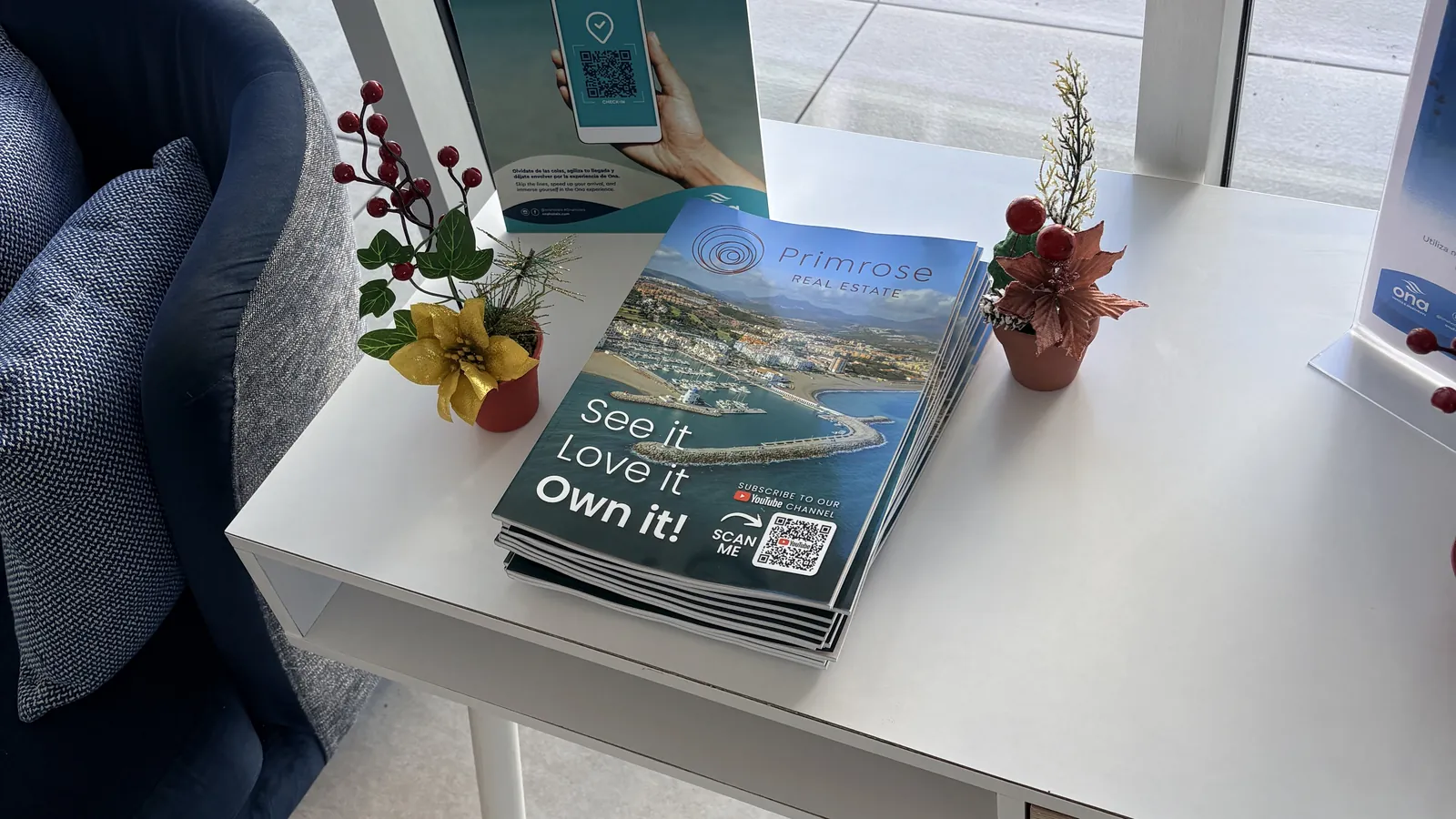
Your audience is two groups. One is here: at the hotel, in a restaurant, on a viewing trip. The other is at home doing research, often months before the next visit. A magazine ad reaches both, but not by the same route.
How long an ad keeps working
A paid campaign stops when the budget runs out. A social post slides down the feed as soon as the next one appears. A magazine page stays:
- Ideal Home, the annual new-developments edition, is distributed for eight months, from May to December, and stays online for twelve.
- Agency Magazine comes out three times a year, in April, August and December. Each edition is distributed until the next one arrives, and the digital version remains available afterwards.
How long an ad keeps working
Schematic illustration based on Ideal Home.
What this means for your marketing
Your ad has to hold up in month eight. An offer “until the end of June” is an irritation in October. Plan the design for the whole run, not for publication day.
Where your page is read
In print, the magazine sits where people have time: hotel receptions, restaurants, waiting areas and agency offices. It is read while waiting, not while scrolling. That is the strength of print and also its limit: someone looking at the page cannot click it.
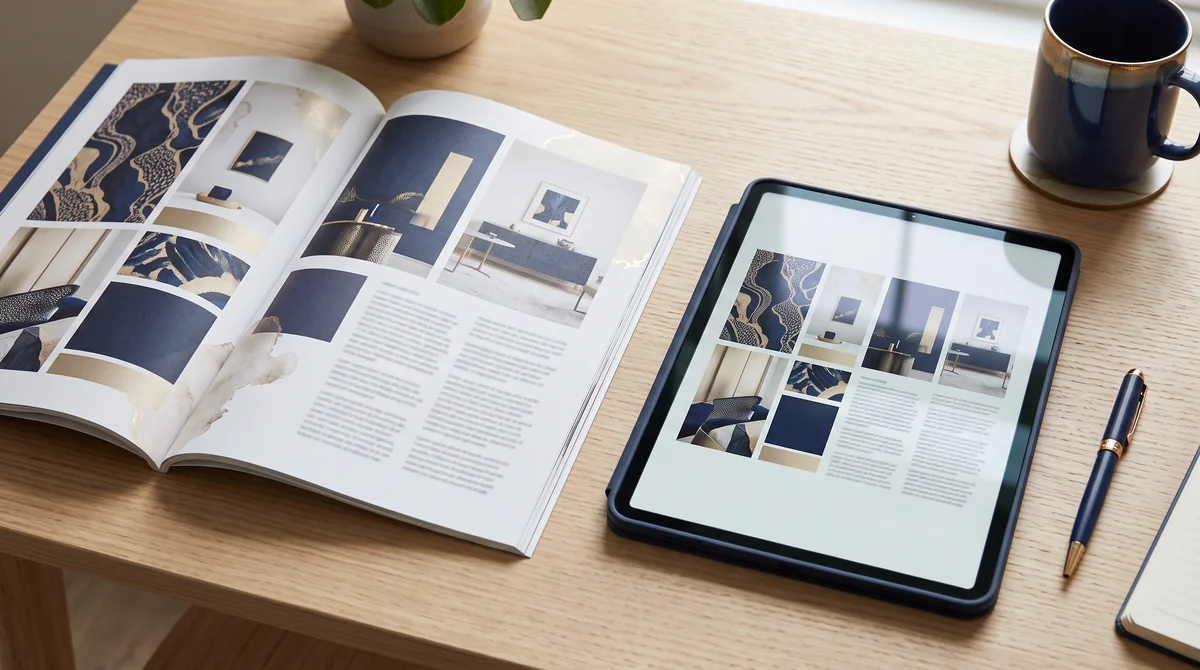
Digitally, the edition is published as a page-turning magazine. It is shared through the participating agencies' own channels, newsletters and social media. With Agency Magazine, each agency sends its own edition to its clients, and your ad travels with it. We explain how virtual magazines work on a separate page.
What this means for your marketing
In print, your ad needs a message that lands in three seconds and a route online: the QR code. In digital, it needs a link that takes readers where they can act. Your homepage is rarely that place.
Print and digital side by side
| Digital | ||
|---|---|---|
| Lifespan | until the next edition; 8 months for Ideal Home | 12 months online (Ideal Home), then in the archive |
| Reading moment | on the coast, with time: hotel, restaurant, agency office | at home or on the move, often while researching |
| Audience | visitors, residents, buyers on viewing trips | prospects in their home country, agencies’ clients |
| Language | one page for everyone: short lines, contact in several languages | link to the right language version of your website |
| Measurement | QR scans, asking “where did you see us?” | clicks and visits tracked with UTM parameters |
| What the ad must do | be understood in three seconds | make the next step one click away |
Five levers to turn one page into two channels
1. One design, two routes
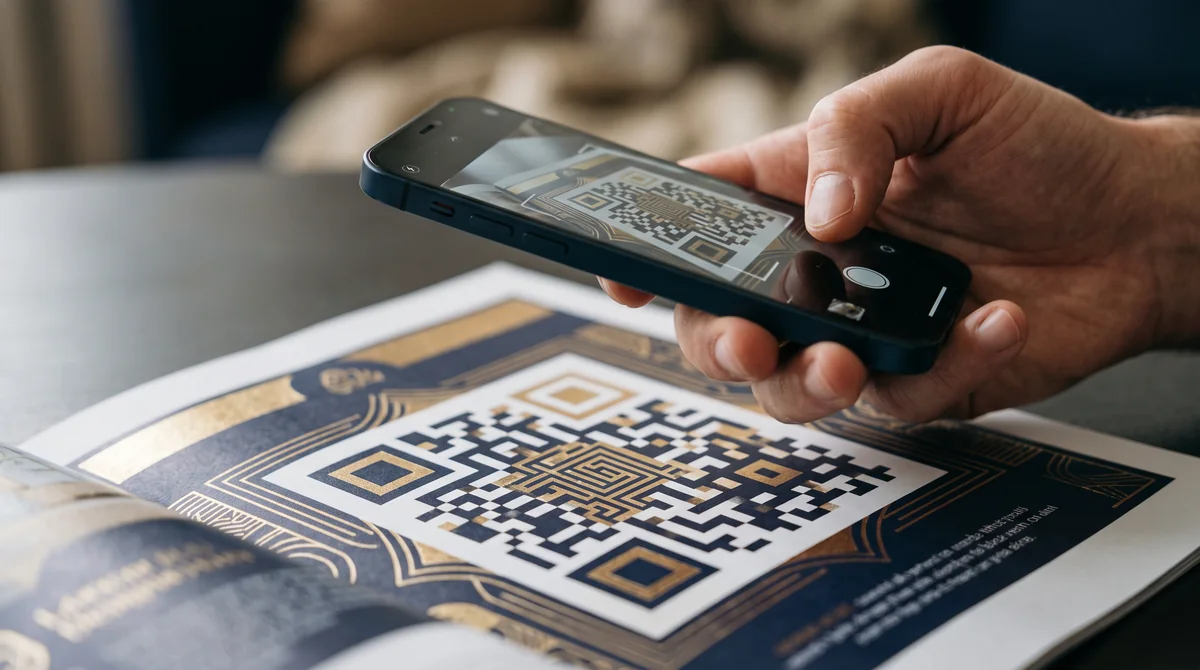
Put a dynamic QR code on the printed ad and a clickable link in the digital edition. Both lead to the same landing page, but with different UTM parameters. That way Google Analytics shows you separately what comes from the printed copy and what from the online edition. A dynamic code has a second advantage: you can change the destination during the run without reprinting. Our article on dynamic QR codes explains how.
2. Design for the whole run
An ad that spends eight months at a reception desk cannot carry a seasonal offer. Work with a message that is as true in November as it is in May: what you solve, for whom and how to reach you. Current offers belong on the landing page behind the QR code, which you can update at any time.
3. Put the ad to work again
A printed page is also proof. Show it on your website, in your newsletter and on LinkedIn, with a line such as “As featured in this season’s magazine” and a link to the digital edition. You carry the ad into channels you control, at no extra media cost.
4. Speak your buyer’s language
British, Dutch and German buyers are near the top of the foreign ranking. A developer’s marketing team planning for them does not need a trilingual ad. But one line and one landing page in the language of your main buyer group make it easier to get in touch. If you want to reach German-speaking buyers specifically, Spanientrends is a channel built for exactly that.
5. Measure what can be measured
QR scans and clicks can be counted. Phone calls only if you ask where the enquiry came from. The effect on awareness and trust cannot be measured precisely. That is not an argument against the ad, but it is one for honest expectations. Do not judge a magazine page after two weeks as if it were a click campaign. Judge it over its whole run.
When the combination does not pay off
Not every message belongs in a magazine. If you need to sell a promotion within four weeks, paid search or social ads are the more direct route. If there is no suitable page behind the QR code, you waste the digital half. And if the budget will not stretch to a proper design of your own, the page will spend eight months working against you rather than for you.
Checklist before you book
- Who should the ad reach: visitors on the coast, prospects at home, or both?
- Will the message still be true at the end of the run?
- Does the QR code lead to a dedicated landing page rather than your homepage?
- Do the QR code and the digital link carry different UTM parameters?
- Is there one line and one landing page in your main buyer group’s language?
- Where will you show the ad once it is out: website, newsletter, LinkedIn?
Plan your next edition
Your ad, working in both channels
Ideal Home is aimed mainly at developers; Agency Magazine at local businesses that work with buyers. Which edition fits your goal, and how to set up your ad for both channels, is something we can work out in a first conversation. Formats, prices and dates are in the Media Pack.
Request the Media PackBook my free consultationWant to stay up to date on the market, media and marketing on the Costa del Sol? Our newsletter comes out once a month.