
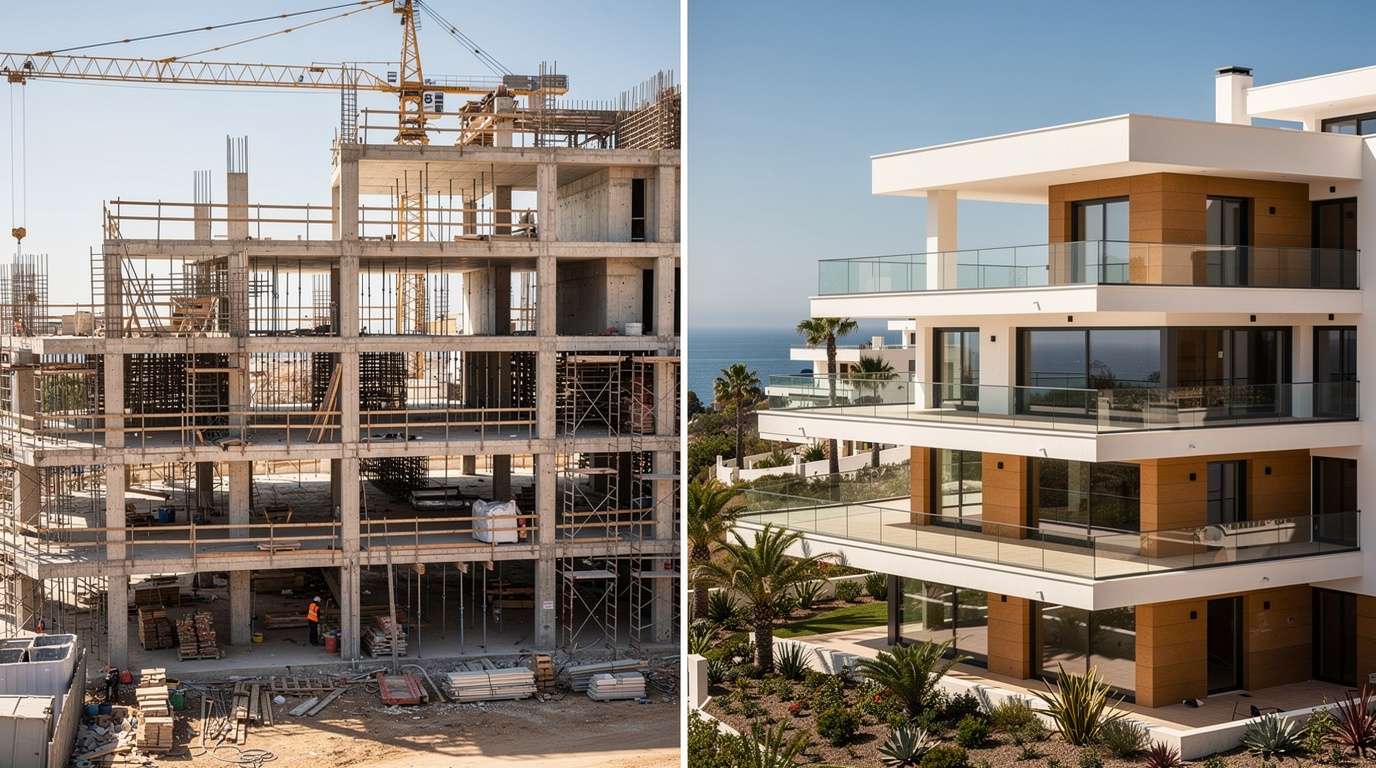
Most development marketing budgets peak twice: once for renderings before a single foundation is poured, and once for photography after the keys are handed over. In between – the twelve, eighteen, twenty-four months where the building actually rises – almost nothing gets produced, even though a camera is often already running on-site for progress documentation. That footage sits in a folder nobody outside the site office ever opens.
That gap is the subject of this article. Construction timelapse is treated almost exclusively as a documentation task on the Costa del Sol. Reframed correctly, it's one of the cheapest, most under-used marketing channels a developer has – and it happens to matter most exactly when the buyer is furthest away.
The effort involved is modest. This isn't about organising extra shoot days or buying new camera equipment – in most cases the infrastructure is already running. It's about deliberately doing something with material that already exists, instead of letting it sit unused.
The market right now: fewer sales, more new supply on the way
Before the marketing case, the numbers that make this article relevant right now.
Residential sales in Málaga province fell 9.3% year-on-year in the first quarter of 2026 – 8,837 transactions against 9,741 in the same period of 2025 (El Debate, 2026; Prisma Global, 2026, both based on the official property registry data). This isn't a price correction – after five years of near-continuous growth, the market is simply moderating in volume.
Nationally, the picture is more nuanced. According to the Colegio de Registradores official registry statistics, Spain recorded 178,096 home sales in Q1 2026 – a slight 0.1% dip quarter-on-quarter and 1.9% year-on-year, still close to the highest levels since 2007 (Colegio de Registradores/CORPME, 2026; independently confirmed by aquimicasa.net, 2026). New-build sales, notably, rose 7.2% quarter-on-quarter, while the resale segment slipped 2%.
At the same time, more supply is entering the pipeline. New housing building permits in Spain reached 139,016 units in 2025 – up 8.8% on 2024 (Ministerio de Transportes y Movilidad Sostenible, 2026; independently confirmed by Forbes España, 2026).
What this means for your marketing: more projects are reaching the market over the next 12–24 months, while the pool of active buyers isn't growing at the same pace. Competing purely on ad spend and portal visibility buys reach within a shrinking audience. The real lever is trust – the project that visibly shows progress wins over the one that only shows renderings.
Why moving image matters right now
Video is no longer experimental marketing – it's the baseline. 91% of businesses now actively use video as a marketing tool (Wyzowl, 2026), and 93% of marketers rate it as an important part of their strategy (HubSpot, 2026) – two independent annual surveys reaching the same conclusion: not using video in 2026 is the exception, not the norm.
For the international property buyer, there's a second point worth understanding. Spain legally mandates buyer protection for off-plan purchases. Under the Building Ordinance Act (Ley 38/1999, as amended by Ley 20/2015), developers must guarantee stage payments made during construction through a bank guarantee or surety insurance, held in a segregated account (boe.es, 2015; Banco de España, Cliente Bancario, 2026). That protects the buyer's money reliably.
What that law doesn't do is settle the buyer's underlying question: is this actually being built, on schedule, as promised? That gap – between legal protection and emotional confidence – is exactly the gap visible construction progress closes.
What this means for your marketing: the legal guarantee protects the deposit, not the confidence. Showing construction progress regularly supplies the missing piece – particularly relevant for buyers purchasing remotely or off-plan, who can't simply drive past the site to check.
Construction timelapse as an ongoing marketing engine, not just a record
Here's the actual point: the camera already running for site documentation can, with minimal extra effort, serve two purposes at once – a record for you, marketing for sales.
A monthly timelapse milestone, occasional drone footage and a few crew shots build up into a genuine content library over the build – usable both during presale (to reassure still-undecided prospects) and after completion (as proof of delivery quality for future projects).
That content works across several channels at once:
- The project landing page, where it backs up the renderings with evidence that the building is actually rising, not just planned.
- Social media, particularly LinkedIn, now firmly established as the leading B2B video channel and a direct line to international investors, agents and institutional partners.
- Magazine advertorials, through our own Ideal Home and Spanientrends network, which already reaches international and DACH buyers in places they're already spending time.
A typical scenario shows the difference: a 40-unit development runs 14 months from groundbreaking to handover. Without a timelapse routine, a prospect might see two or three updates in that window – usually only on request, and often days late. With a fixed timelapse routine, that same window produces twelve to fourteen distinct content moments to spread across the website, social channels and sales materials, without a single extra shoot day. The difference isn't budget. It's routine.
A simple cadence works well: one timelapse milestone per month, supplemented every two to four weeks with additional content – surroundings, finishes, short progress notes. Combined with drone footage and a 360° tour of the show home, it forms a complete visual ecosystem that closes the distance between the construction site and the remote buyer. We've covered how drone footage speeds up sales in our article on aerial photography for real estate, and how virtual walkthroughs work in practice in our article on 360° virtual tours.
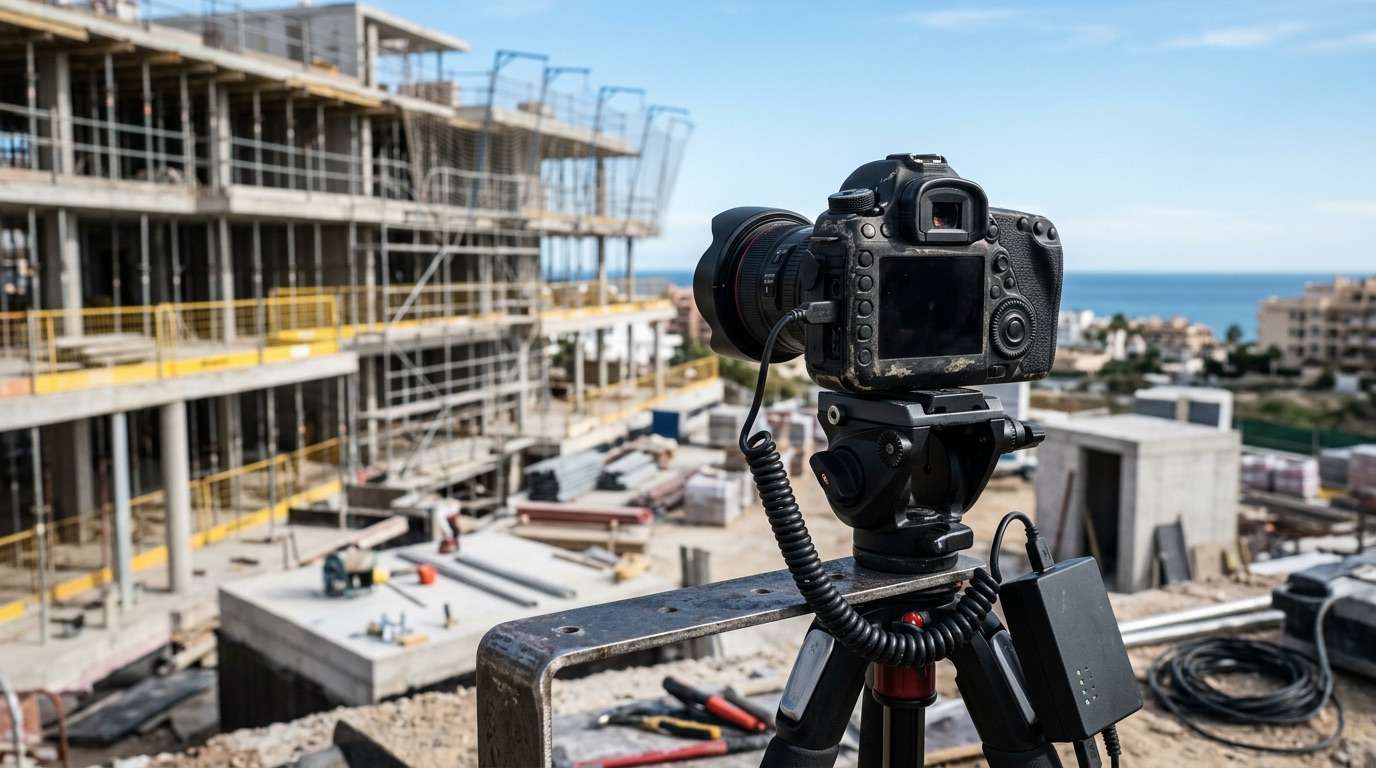
The extra effort, realistically. The base infrastructure – camera, power, ideally remote access – should already exist for site documentation purposes. The additional step is editorial, not technical: someone needs to review the raw footage monthly, cut a short clip, and push it into the existing channels. That can be outsourced without touching the construction schedule itself, and it costs a fraction of a standalone video shoot for every milestone.
The roadmap: staying a step ahead of the competition
Three concrete steps to turn construction timelapse into an active marketing channel.
Step 1 – set up from day one. The timelapse camera belongs on site from the first groundworks, not once the structure is topped out. Starting late means missing the most compelling stretch of footage: the shift from empty plot to recognisable building.
Step 2 – a fixed distribution routine. Even the best footage goes unseen without a plan to publish it. Website, social media and magazine placements should be scheduled in advance, and a construction update should be a standard part of the sales pack for international prospects – especially the ones who can't fly over to check in person. Format matters here too: short 15-30 second clips work best for social media and first-touch outreach, while a slightly longer monthly recap fits better on the project landing page and in direct sales conversations. One format for every channel is rarely the right format for any of them.
Step 3 – one partner for the whole visual picture. Photography, video, drone, 360° tours and construction timelapse work best as a coordinated package rather than separate briefs to different suppliers at different stages. That keeps the visual identity consistent across the entire build – and keeps the project recognisable throughout.
Q1 2026 year-on-year
Spain, 2025
actively use video
Sources: Colegio de Registradores (CORPME) / El Debate / Prisma Global, 2026 · Ministerio de Transportes y Movilidad Sostenible / Forbes España, 2026 · Wyzowl / HubSpot, 2026
Let's talk about your project
If the site camera is already running, it should be working for your marketing too. At ADS Marketing, we build construction timelapse into a full visual package alongside photography, video, drone and 360° tours – scheduled around your build programme and your sales calendar.
Book a call about your project directly – twenty minutes is usually enough to sketch out a concrete recommendation for your development.